
What to Do With Fall Leaves: Mulch, Compost, or Bag Them?
A light leaf layer can be mulch-mowed into the lawn; thicker piles are better shredded for mulch or compost. Shredded leaves break down faster, mat less, and store more compactly than whole leaves. Save extra dry leaves as carbon-rich "browns" for next year's compost, use a moderate shredded layer on raised beds over winter, and remove leaves that are diseased, chemically contaminated, or covering drains and walkways.
Disclosure: YardCalc may earn a commission from purchases or referrals made through links on this page, at no extra cost to you.
Every fall, homeowners rake up one of the most useful materials their yard produces all year — and then pay to have it hauled away. Fallen leaves can become mulch, a compost ingredient, winter protection for garden beds, organic matter, or future “brown” material for next year's compost pile. They're a free input for almost every soil-building project on this site.
That doesn't mean every leaf should be left exactly where it falls. A thick mat of whole, wet leaves can smother grass, block light, trap moisture, clog drains, turn slippery on a sidewalk or deck, and generally create more maintenance than it saves. The better question isn't “should I keep all my leaves?” It's “what is the best use for this pile of leaves?”
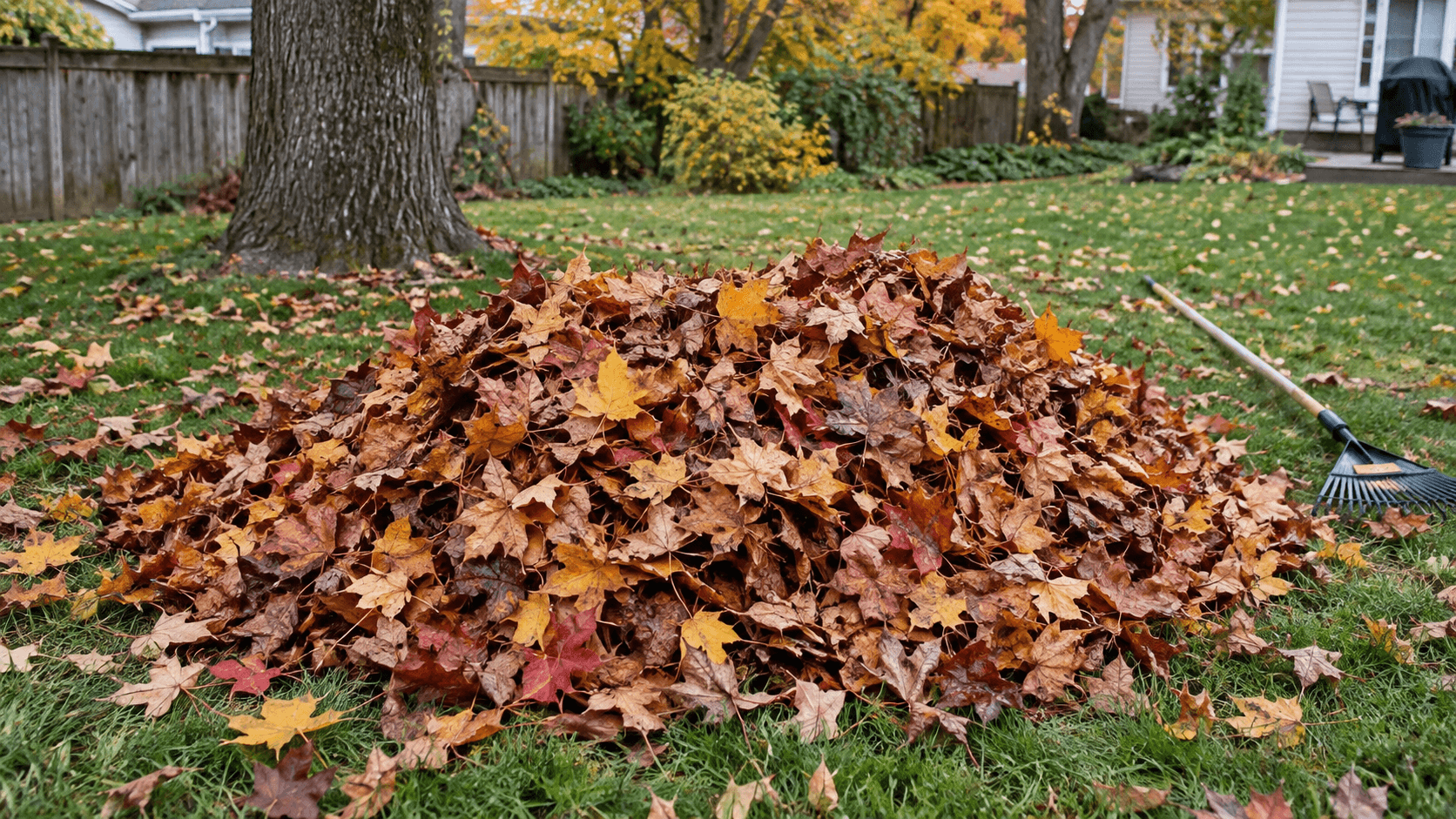
Quick Answer: What to Do With Your Leaves
| Situation | Best Use |
|---|---|
| Light layer across lawn | Mulch-mow into the grass |
| Large pile of healthy leaves | Shred and compost |
| Vegetable or raised beds | Use shredded leaves as winter mulch |
| Bare soil around shrubs | Apply shredded-leaf mulch |
| Leaves worth saving | Shred and store dry |
| Diseased leaves | Remove rather than casually compost |
| Leaves covering drains or pavement | Remove immediately |
| Thick wet mats on lawn | Rake, shred, or relocate |
The key distinction running through almost every row above is whole leaves versus shredded leaves. Whole leaves overlap like sheets of paper and mat together once they're wet. Shredded leaves:
- Break down faster
- Mix into compost more easily
- Take up less storage space
- Make better mulch
- Are far less likely to form a dense, water-trapping mat
1. Mulch Leaves Into the Lawn
A light or moderate layer of leaves can often be mulch-mowed directly into the lawn instead of raked up at all. This works best when the grass is still mostly visible, the leaves are reasonably dry, and your mower can chop them finely enough that the fragments settle down between the grass blades instead of sitting on top. Mowing twice, in different directions, usually gets the pieces small enough to disappear into the turf.
When There Are Too Many Leaves
If the lawn is largely hidden beneath a dense leaf layer, don't leave it intact all winter. A heavy, unbroken layer blocks sunlight, traps moisture, reduces air movement, smothers turf, and can form a wet mat that takes weeks to dry out. When that happens, collect some of the material and put it to use elsewhere instead of mulch-mowing all of it in place.
The problem usually isn't the leaves themselves. It's having too many whole leaves in one place.
2. Shred Leaves and Use Them as Mulch
Shredded leaves make solid seasonal mulch around shrubs, perennials, trees, raised beds, vegetable gardens after harvest, and any bare garden soil. For most beds, roughly 2–3 inches of loosely shredded leaves is a practical starting point — similar to the depth guidance for conventional bark mulch. Keep the layer away from tree trunks, shrub stems, plant crowns, siding, and wood posts. Cover the soil, not the plant.
If you want to compare how much shredded leaf mulch you're generating against what conventional bagged or bulk mulch would cost for the same beds, the mulch calculator gives you cubic yards and an estimated cost for reference.
Why Shredding Helps
Whole leaves overlap like sheets of paper and can mat together once they're wet, which slows airflow and decomposition. Shredding increases exposed surface area, speeds decomposition, reduces matting, helps leaves stay put in beds instead of blowing around, improves mixing in a compost pile, and reduces how much storage space a given volume of leaves takes up.
If your property produces more leaves than a mower can reasonably handle, an electric leaf mulcher/shredder can make the process much easier, chopping a large volume of leaves down to a fraction of the space before they go into beds or a compost pile.
3. Compost Your Leaves
Dry leaves are an excellent carbon-rich “brown” compost ingredient. Browns also include straw, shredded cardboard, and other dry plant material. “Greens” are the nitrogen-rich side of the pile — grass clippings, kitchen vegetable scraps, coffee grounds, and fresh garden waste. A mixed pile with both browns and greens generally performs better than either one alone.
A pile made entirely from leaves will still decompose — it will just generally take longer than a pile that also has some fresh green material mixed in.
Shred First If You Can
Shredding leaves before composting increases surface area, helps microbes access the material faster, makes piles easier to mix, reduces volume, and usually speeds decomposition overall.
4. The Composter I Actually Use — And the Tumbler Tradeoff
I use an FCMP Outdoor 37-gallon steel composter at home, and overall I like it. The rotating design makes it easy to mix the material and introduce air without manually turning the pile with a fork — I just spin it.
The downside is getting finished compost back out. Once the tumbler is heavy and full of partially finished compost, unloading material through the opening can be awkward. I don't really consider that a flaw specific to this model — it's the tradeoff with rotating composters in general. For me, the easier mixing is worth it.
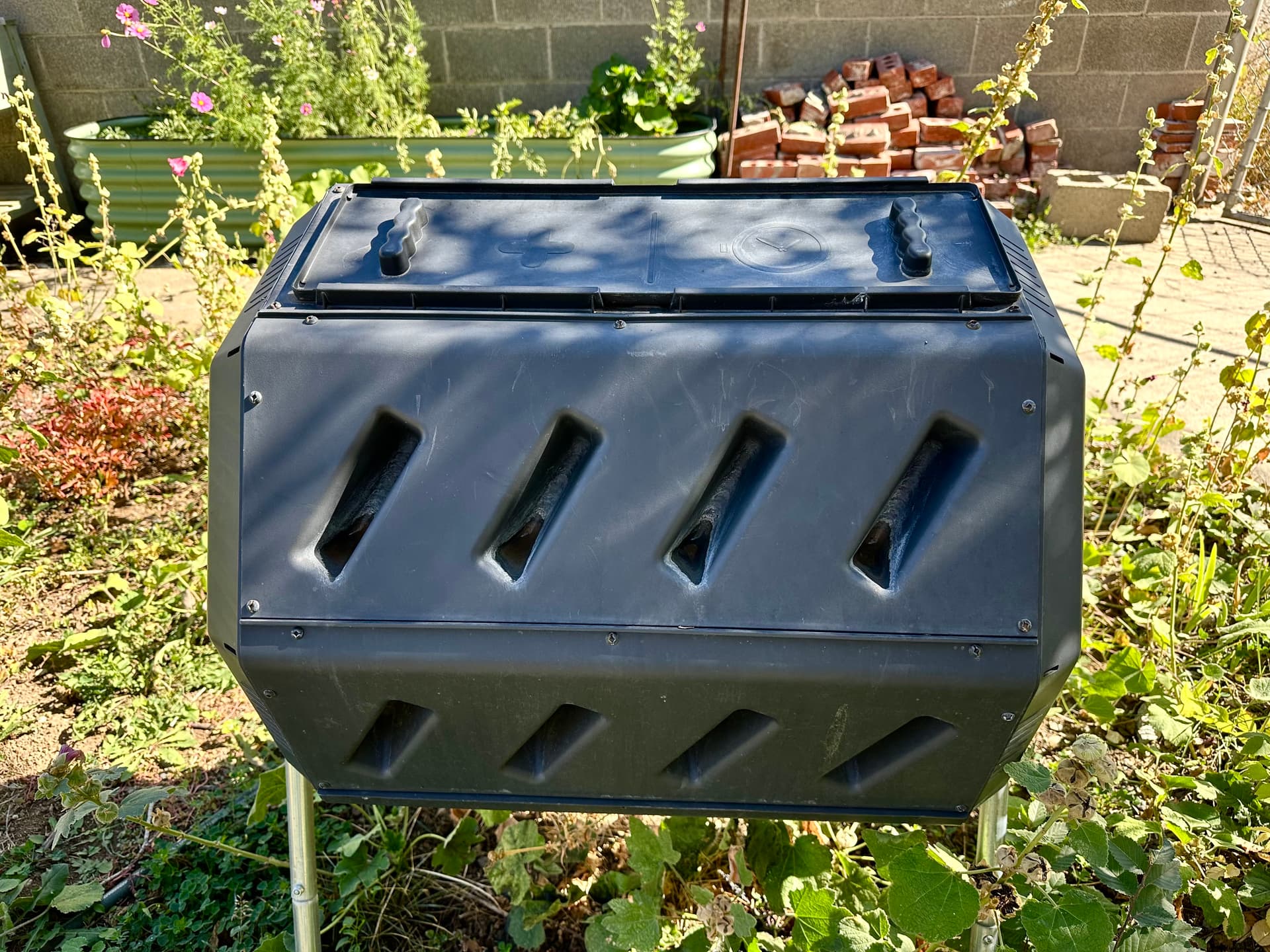
Tumbler vs. Stationary Bin
If easy unloading matters more to you than easy mixing, a stationary bin like the Redmon 65-gallon compost bin is worth considering. I don't own this one, so I can't speak to it firsthand — but the design tradeoff versus a tumbler is straightforward.
| Feature | Tumbler (FCMP) | Stationary Bin (Redmon) |
|---|---|---|
| Mixing | Very easy — rotate | Manual |
| Aeration through turning | Easy to do frequently | Requires manual mixing |
| Loading | Through hatch/opening | Open-top access |
| Unloading | More awkward once heavy | More direct access |
| Capacity | 37 gal | 65 gal |
| Best for | Easy mixing | Easy access + more volume |
My take: I'd choose a tumbler if easy mixing is the priority. If getting finished compost in and out easily matters more to you, I'd lean toward a stationary bin instead. Neither one is universally better — they just solve different problems.
A 37-Gallon Composter Won't Hold a Whole Tree's Worth of Leaves
A composter in this size range won't hold the leaf drop from a large mature tree all at once, and that's fine — it's better suited to incremental batches: shredded leaves, kitchen scraps, and garden waste mixed in over time rather than one giant fall dump. That limitation is exactly why storing extra leaves for later is worth doing.
5. Save Dry Leaves for Next Year
This is underrated. During summer, most homeowners have plenty of grass clippings, fresh garden waste, and food scraps — the nitrogen-rich “greens” — but relatively few dry “browns.” Fall leaves solve that problem months later. Shred them first if practical, store them relatively dry, and add them to future compost piles as needed.
A few practical storage options: a spare trash can with a lid, a simple wire enclosure, a covered pile under a tarp, or reusable yard waste bags. They're still just bags, but reusable yard bags are useful if you want to store or move leaves without burning through disposable paper bags every season.
6. Put Leaves on Raised Beds
Once vegetable production is finished for the year, shredded leaves can cover exposed raised-bed soil through winter. A moderate layer can reduce erosion, protect surface structure, moderate freeze-thaw exposure, slowly add organic matter, and provide habitat for soil organisms. The same distinction from earlier applies here: a moderate shredded layer is useful; a thick, wet pile of whole leaves is not.
If you're planning or building beds for next season, see the raised garden bed guide and use the raised bed calculator to plan soil volume. Come spring, you can remove whatever hasn't broken down or just work partially decomposed material into the bed where it makes sense.
7. Can You Mix Leaves Into Garden Soil?
Carefully. Fresh leaves contain a lot of carbon, and the microbes that break down carbon-rich material use nitrogen to do it. Leaves don't permanently “steal” nitrogen from your soil, but burying a large amount of fresh, undecomposed leaves directly into the active root zone can temporarily tie up some available nitrogen while decomposition is underway.
A better sequence: shred the leaves, compost them first (or at least let them begin breaking down), use them as surface mulch rather than burying them, and incorporate decomposed material into the soil later. For more on when topsoil, compost, and garden soil blends are actually appropriate, see Topsoil vs. Compost vs. Garden Soil.
8. What Is Leaf Mold?
Leaf mold is different from traditional mixed compost. It's primarily decomposed leaves broken down mostly by fungal activity rather than the bacterial process that drives a typical compost pile. It's a slower process — leaf mold can take many months to a year or more depending on conditions. The result is useful for improving soil texture, increasing moisture retention, top-dressing beds, blending into raised-bed mixes and potting mixes, or using as surface mulch.
Leaf mold versus mixed compost is a big enough topic to deserve its own breakdown — something worth covering in a future article.
9. Leaves You Should Not Automatically Compost
Diseased leaves
Some fungal or bacterial diseases can persist in a cool backyard compost pile that never heats up reliably. If a pile doesn't consistently heat, disposing of seriously diseased plant material through your local yard-waste program is often the safer option rather than composting it at home.
Chemically contaminated leaves
Avoid composting leaves contaminated with motor oil, paint, road chemicals, treated construction waste, or obvious chemical spills.
Black walnut leaves
Black walnut leaves contain juglone, a compound that breaks down during decomposition. Properly composted black walnut leaves may eventually be usable, but it's worth avoiding large amounts of fresh walnut leaves placed directly around sensitive plants.
10. What About Pine Needles?
Pine needles decompose more slowly than broad leaves, work well as a surface mulch, mat together less than broad leaves, and are useful around shrubs and ornamental beds. One common myth is worth correcting carefully: pine needles do not permanently acidify ordinary garden soil simply because they're used as surface mulch. Any pH effect from mulch alone is modest and shouldn't be treated as an absolute rule.
11. Should You Leave Some Leaves for Insects?
Leaf litter can provide overwintering habitat for beneficial insects, caterpillars, beetles, spiders, and other small organisms. That doesn't mean every leaf needs to stay put. A practical compromise: clear leaves from the lawn, clear walkways, clear storm drains, but leave some material under shrubs and in natural corners that get less foot traffic, then shred or compost the rest.
A yard doesn't need to look abandoned to provide habitat.
12. When You Should Bag or Remove Leaves
Block storm drains
Leaves piled over a storm drain risk standing water and drainage problems — clear these right away.
Cover sidewalks or steps
Wet leaves become slippery fast. Clear walkways and steps as leaves accumulate.
Form heavy mats on lawn
Relocate or shred thick wet mats rather than leaving them to smother the grass underneath.
Are seriously diseased
Dispose of according to your local yard-waste practices when cold composting isn't appropriate.
Exceed what you can realistically use
There's no prize for keeping every leaf. Compost what you can use, save what's practical, and dispose of the excess responsibly.
13. What Not to Do With Fall Leaves
- Don't burn them unless it's legal and appropriate — leaf burning contributes to air pollution and is restricted in many areas.
- Don't leave thick, wet mats on the lawn all winter.
- Don't pile leaves against tree trunks.
- Don't bury huge quantities of fresh, whole leaves directly in garden soil.
- Don't send away useful organic material and buy it back in spring— bagging leaves in October, paying to have them hauled away, then buying mulch and compost again in spring is a cycle that's often unnecessary if the leaves are healthy and you have room to use them. See What Not to Throw Away During Yard Cleanup for more material worth keeping beyond just leaves.
14. A Simple Fall Leaf Plan
Lawn
Mulch-mow a light layer
Garden beds
Use 2–3 inches of shredded leaves
Raised beds
Use moderate shredded cover after harvest
Compost
Mix shredded leaves with nitrogen-rich material
Extra leaves
Store dry for future composting
Diseased/contaminated leaves
Remove
Frequently Asked Questions
- Are fallen leaves good for compost?
- Yes. Dry leaves are an excellent carbon-rich compost ingredient. Shredding them first generally speeds decomposition and makes them easier to mix with nitrogen-rich material.
- Can I use leaves instead of mulch?
- Yes. Shredded leaves can work well as seasonal mulch around shrubs, perennials, raised beds, and vegetable gardens. Whole leaves are more likely to mat together.
- Should I rake leaves off my lawn?
- A light layer can often be mulch-mowed into the lawn. Remove or shred heavier layers that cover most of the grass.
- How deep should leaf mulch be?
- Roughly 2–3 inches of loosely shredded leaves is a practical starting point around many established plants and bare garden beds. Keep leaves away from trunks and stems.
- Can I put leaves directly into raised garden beds?
- Yes. Shredded leaves make useful winter surface mulch after harvest. Avoid filling the bed with a thick compacted layer of whole wet leaves.
- How long do leaves take to compost?
- Timing varies widely. Shredded leaves mixed with nitrogen-rich material generally break down faster than whole leaves left alone. Pure leaf mold often takes many months to a year or longer.
- Should I shred leaves before composting?
- You do not have to, but shredding increases surface area, reduces volume, and usually speeds decomposition.
- Can I store leaves for composting later?
- Yes. Dry shredded leaves are useful to save because they provide carbon-rich brown material when grass clippings and fresh garden waste become abundant in spring and summer.
Before You Bag Them, Think About Next Spring
Fall leaves can be mulch, a compost ingredient, winter protection, organic matter, future carbon-rich browns, or valuable soil-building material over time. Use what makes sense, remove what creates problems, and don't feel obligated to make the entire property spotless.
Related tools and guides: mulch calculator, Topsoil vs. Compost, Raised Garden Bed Guide, raised bed calculator, and What Not to Throw Away During Yard Cleanup.
Ready to run the numbers?
Estimate how much mulch your landscape beds would otherwise need — useful for comparing shredded leaves with conventional mulch.
Calculate Mulch for My Beds