
How Deep Should Landscape Rock Be? Depth Guide by Project
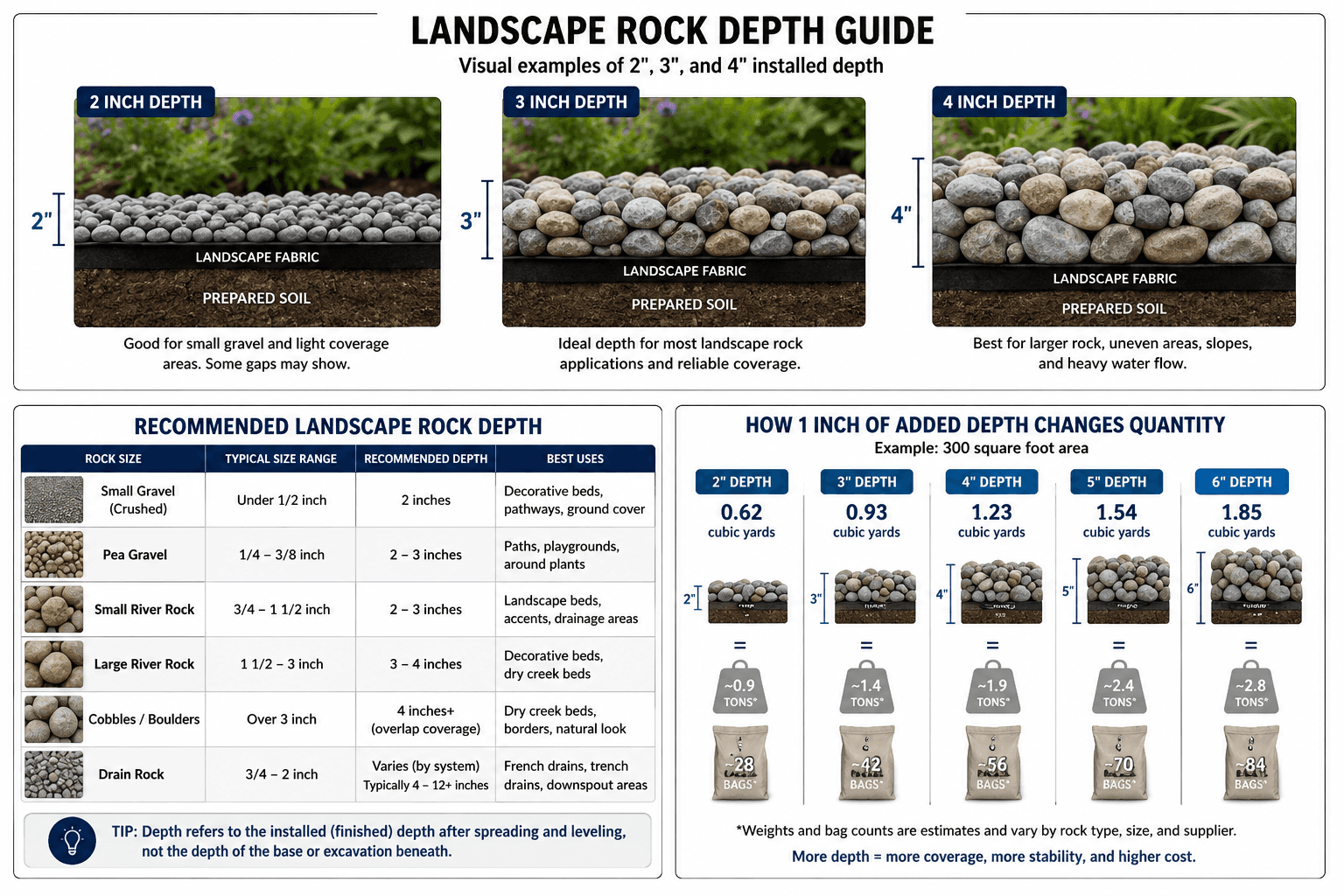
Most decorative landscape beds need 2–3 inches of rock. Small gravel can often cover at 2 inches; larger river rock (1½–3 inch) needs 3–4 inches. Dry creek beds need at least 6 inches of depth in the channel. Drainage systems are designed around pipe size — not the decorative-bed rule. Always calculate the missing depth when refreshing an existing bed, not the full target depth.
Disclosure: YardCalc may earn a commission from purchases or referrals made through links on this page, at no extra cost to you.
The right depth for landscape rock depends on the size of the stone and what the area needs to do. For most decorative landscape beds, 2 to 3 inches is the practical starting range. Smaller gravel can often provide full coverage at 2 inches, while larger river rock may need 3 to 4 inches before the soil or landscape fabric underneath is fully concealed.
Drainage trenches, driveways, paths, and dry creek beds require different depths because the rock is doing structural or hydraulic work — not just covering a surface. Use the river rock calculator to estimate cubic yards, tons, and cost once you know the right depth for your project.
Quick Reference: Depth by Project
| Project or Rock Type | Typical Depth |
|---|---|
| Small decorative gravel (under ½ inch) | 2 inches |
| Pea gravel in landscape beds | 2–3 inches |
| ¾- to 1½-inch river rock | 2–3 inches |
| 1½- to 3-inch river rock | 3–4 inches |
| Cobbles over 3 inches | 4 inches or overlapping coverage |
| Rock around established shrubs | 2–3 inches |
| Low-traffic gravel path surface | 2–3 inches over prepared base |
| Dry creek bed channel | At least 6 inches deep |
| French drain / drainage trench | Designed to pipe size and drainage requirements |
| Refreshing an existing rock bed | Only the missing depth (see below) |
Why Depth Matters
Rock installed too shallow tends to look unfinished and shift quickly:
- Soil or fabric remains visible between stones
- Small stones migrate into adjacent lawn and beds
- Organic debris collects in exposed gaps and becomes a weed seedbed
- The installation requires more frequent maintenance
Rock installed unnecessarily deep creates the opposite problems:
- Material cost rises quickly — one extra inch across 500 sq ft adds roughly 1.5 cubic yards
- Edging may no longer contain the rock at the finished elevation
- Stone piles against plant stems or structures
- Heavy layers make future removal significantly harder
The goal is enough depth to create stable, overlapping coverage — not the maximum possible.
How Stone Size Changes Required Depth
A one-inch layer may conceal soil under very small crushed gravel, but the same layer barely holds a single course of two-inch river rock. Larger stones create larger voids between pieces — the bed needs enough depth for pieces to overlap rather than sit in a sparse single layer.
Small gravel — under ½ inch
~2 inchesExamples: Crushed granite, small pea gravel, fine decorative gravel, marble chips, small lava rock
A layer thinner than 2 inches may look complete initially but expose soil after foot traffic and settlement.
Medium rock — ¾ to 1½ inch
2–3 inchesExamples: River rock, landscape gravel, decorative stone, drain rock, washed gravel
Three inches provides more reliable coverage where the soil or fabric contrasts strongly with the stone color.
Large river rock — 1½ to 3 inch
3–4 inchesExamples: Large river rock, angular landscape stone
A two-inch layer of two- or three-inch stone is effectively only one rock deep in many places and looks sparse.
Cobbles — over 3 inch
4 inches+ or overlapping coverageExamples: Large cobbles, boulders, oversized decorative rock
Cobbles are typically arranged rather than spread. Combine with smaller fill rock to close gaps and produce a natural look.
How Deep Should River Rock Be?
For a typical decorative river-rock bed, start with:
2"
Light coverage
Small river rock, flat smooth ground, refreshing an existing layer, budget-conscious projects
3"
Recommended default
Most residential beds, new installations over fabric or soil, reliable coverage for ¾–1½ inch stone
3–4"
Larger stone
Rock over 1½ inches, uneven ground, slopes, areas where water regularly moves through
For a typical residential bed, small ¾-inch river rock at 2–3 inches or 1.5-inch river rock at 3 inches is the most common starting point. Use code MEADOWLARK for 5% off first-time bulk orders.
See How Much River Rock Do I Need? for a complete buying and coverage guide including size selection, bags vs. bulk pricing, and what to install underneath.
How Deep Should Rock Be in a Dry Creek Bed?
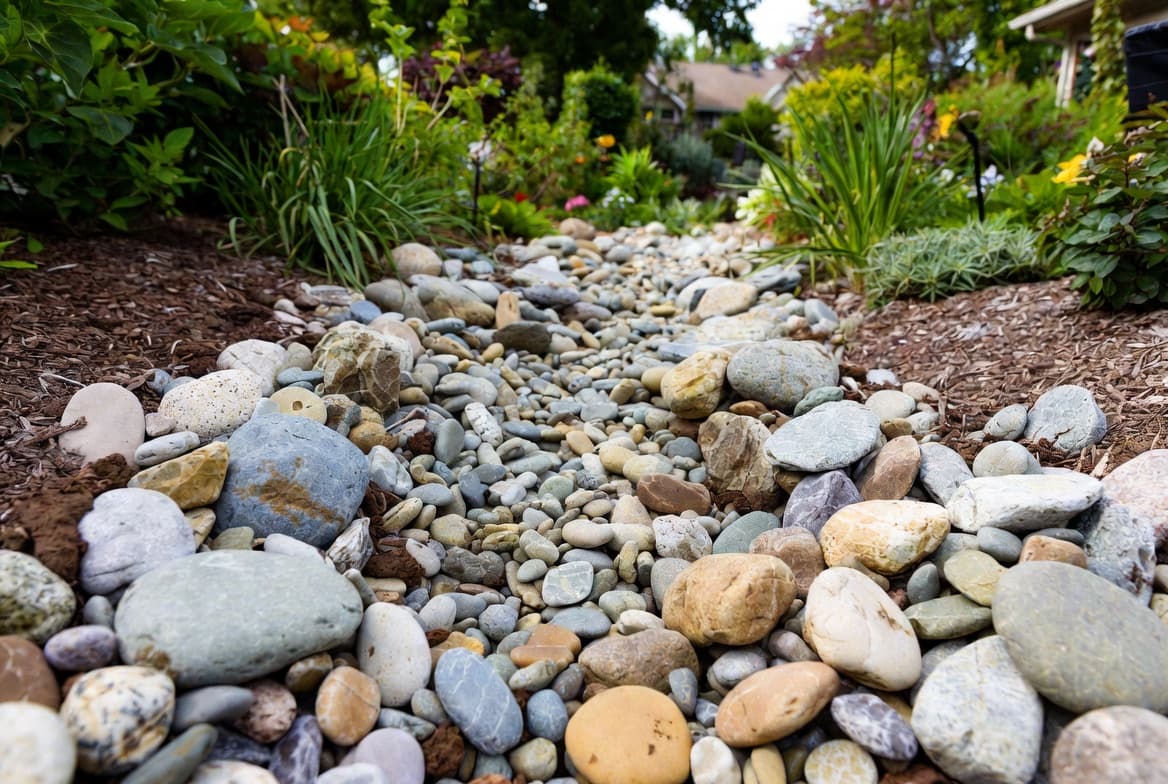
A dry creek bed is not simply a decorative trench. The channel must be shaped deeply enough to collect, slow, or convey runoff. The channel itself is typically at least 6 inches deep, with depth increasing where greater runoff capacity is required.
The rock installation in a creek bed commonly layers sizes:
- Smaller gravel beneath or between larger stones for drainage and stability
- Medium river rock through the main channel
- Larger cobbles or boulders along bends, edges, and focal points
- A defined outlet where water can safely discharge
- Permeable geotextile — not standard weed barrier — where soil separation is needed
For creek beds that handle real runoff, 1–3 inch river rock is the standard size — large enough to stay in place under flow, varied enough to look natural.
The decorative-bed depth rule of 2–3 inches does not apply here. A creek bed that collects substantial roof runoff or hillside drainage may require professional drainage planning to size the channel correctly.
How Deep Should Rock Be Around Plants?
A decorative rock layer around established shrubs is generally 2 to 3 inches deep. The more important rule is what to avoid: keep rock away from direct contact with trunks, shrub stems, plant crowns, siding, and wood posts. Rock piled against stems traps heat and moisture in the wrong location and makes it harder to inspect the plant base.
Rock is also not always the right choice for planted beds. It is durable but does not decompose into organic matter, improve soil structure, or moderate soil temperature the way organic mulch can. Read River Rock vs. Mulch before converting an actively planted bed to permanent stone.
Does Landscape Fabric Let You Use Less Rock?
Fabric may improve soil separation and reduce how quickly stone sinks into soft ground, but it does not reduce the recommended rock depth. A thin layer still shifts and exposes the fabric underneath — which looks worse than exposed soil.
Use the same depth recommendations whether fabric is present or not. Fabric is most useful in permanent installations that won't be regularly replanted. Read Should You Put Landscape Fabric Under River Rock?, then use the landscape fabric calculator to estimate square footage and roll count before ordering either material.
Gravel Paths, Driveways, and Drainage: Different Rules
Gravel paths
Separate the decorative surface from the structural base. A residential path typically has a compacted soil subgrade, compacted crushed-stone base where needed, and approximately 2–3 inches of finish gravel. The total excavation depth depends on soil strength, drainage, frost conditions, and expected traffic. Do not simply install six inches of loose pea gravel — deep rounded gravel becomes harder to walk through without the structural strength of a compacted crushed-stone base. Use the gravel calculator to estimate each layer separately.
Driveways
A gravel driveway is a layered construction system. The visible surface is only one part of it — a properly built driveway includes a compacted subgrade, large base stone, intermediate crushed aggregate, and a finish surface course. Do not apply the 2–3 inch decorative-rock recommendation to a driveway. For a complete breakdown, read:
Then use the driveway gravel calculator to estimate each layer.
Drainage and French drains
Drainage rock is sized around the drainage system, not the decorative-bed rule. A French drain typically requires washed gravel below, around, and above the perforated pipe — often a much deeper stone section than any decorative bed. Important variables include pipe diameter, trench slope, soil conditions, runoff volume, and local construction requirements. Use the French drain calculator for trench quantities and read the French drain guide before ordering stone.
How to Calculate How Much Rock You Need
Once you know the target depth, use the standard formula:
Length (ft) × Width (ft) × Depth (in) ÷ 324 = Cubic Yards
A 300 sq ft bed at 3 inches: 300 × 3 ÷ 324 = 2.78 cubic yards
Add 5–10% for irregular edges, minor settling, and spreading loss:
2.78 × 1.10 = 3.06 cubic yards — order approximately 3.1 yd³
Coverage per 100 Square Feet by Depth
Depth has a direct linear effect on material quantity. One additional inch across a large area can add several cubic yards and meaningfully change the delivery weight and cost.
| Installed Depth | Cubic Yards per 100 sq ft | Approx. Tons per 100 sq ft |
|---|---|---|
| 1 inch | 0.31 yd³ | ~0.42 tons |
| 2 inches | 0.62 yd³ | ~0.84 tons |
| 3 inches | 0.93 yd³ | ~1.25 tons |
| 4 inches | 1.23 yd³ | ~1.66 tons |
| 5 inches | 1.54 yd³ | ~2.08 tons |
| 6 inches | 1.85 yd³ | ~2.50 tons |
Tonnage estimates use approximately 1.35 tons per cubic yard — typical for rounded river rock and pea gravel. Confirm the actual conversion with your supplier for the specific product, as stone type and size affect weight.
Refreshing an Existing Bed: Only Order the Difference
Do not calculate the full target depth when rock is already present. Measure the existing depth in several locations and order only the missing amount:
Desired depth − Average existing depth = Additional depth needed
A 500 sq ft bed averaging 1.5 inches, target 3 inches: 3 − 1.5 = 1.5 inches needed
500 × 1.5 ÷ 324 = 2.31 cubic yards (ordering for the full 3 inches would double the material)
Before measuring, remove leaves and debris, rake the existing rock evenly, and check depth in both high and low spots. If much of the old stone has sunk into soft ground, adding new material on top is a temporary fix — correcting the soil separation may be more effective.
How to Install Rock at the Right Depth
Remove existing vegetation
Remove grass, weeds, and roots rather than burying them. Rock does not kill established perennials — they push through fabric and gaps.
Establish final grade
Shape the soil so water moves in the intended direction. Rock follows the surface below it and cannot correct poor drainage on its own.
Set edging first
Install edging high enough to contain the finished rock depth without creating a trip hazard or blocking runoff. Edging placed too low is ineffective once rock is in.
Install fabric where appropriate
Use woven landscape fabric in permanent decorative beds. Use permeable geotextile in drainage applications. Skip fabric in regularly replanted beds.
Mark the target depth
Use stakes or marked tools through large beds. Measuring only along the edge often leaves the center too thin.
Spread rock gradually
Distribute material in sections rather than dumping the full load and dragging it across the site — dragging tears fabric and disrupts grading.
Check depth before finishing
Push a ruler through the rock in several locations before removing equipment. Correct thin spots before they are inaccessible.
Clear plant bases and structures
Pull stone away from stems, trunks, siding, and vents. Rock should not be mounded around living plants or against wood.
Common Depth Mistakes
| Mistake | Why It Causes Problems |
|---|---|
| Installing only one visible layer of large rock | A single layer of medium or large stone leaves gaps and shifts easily — fabric shows through |
| Using decorative depth for drainage projects | A French drain or runoff channel must be sized around water capacity and pipe requirements, not appearance |
| Choosing depth without considering stone size | Three-inch cobbles and ⅜-inch gravel need different depths to achieve equivalent coverage |
| Ordering for full target depth when refreshing | An existing 1.5-inch bed topped to 3 inches needs 1.5 inches of new material — not 3 |
| Skipping edging | Even correctly installed rock at the right depth migrates without a physical border |
| Assuming more depth permanently stops weeds | Most long-term weeds in rock beds germinate in debris that accumulates above the surface, not from below it |
| Ignoring finished elevation | New rock should not block drainage, cover siding, bury irrigation heads, or spill into adjacent surfaces |
Frequently Asked Questions
- Is 2 inches of landscape rock enough?
- Two inches can be adequate for small decorative gravel on smooth, prepared ground. Medium or large river rock commonly needs closer to 3 inches for complete coverage. Two inches works well as a light refresh over an existing bed.
- How deep should river rock be?
- Use 2–3 inches for smaller river rock (¾–1½ inch) and 3–4 inches for larger stone (1½–3 inch). Three inches is the safest default for a new installation over bare soil or landscape fabric.
- How deep should a dry creek bed be?
- The channel itself is typically at least 6 inches deep — enough to collect and direct runoff. The decorative-bed recommendations do not apply here. Depth increases with expected runoff volume, slope, and stone size.
- How deep should pea gravel be for a walkway?
- A 2- to 3-inch pea-gravel surface over a properly prepared base is standard. Avoid excessively deep loose pea gravel — rounded stone that is too deep becomes difficult to walk through without the structural support of a compacted base beneath it.
- Is 1 inch of landscape rock enough?
- One inch works as a light refresh over an existing bed but is usually too shallow for a new installation. Soil or fabric typically shows through after the stone settles and shifts.
- How much extra rock should I order?
- Add 5–10% for curved beds, uneven grading, measurement uncertainty, and minor settling. For an existing bed, calculate only the missing depth first, then apply the allowance to that smaller number.
- How deep should rock be around trees and shrubs?
- Approximately 2–3 inches as surface cover. Keep rock away from trunks, root flares, and shrub stems — rock mounded against living stems traps moisture in the wrong place and can cause long-term damage.
Measure, Choose the Depth, Then Order
Most decorative landscape beds need 2 to 3 inches of rock — adjusted for stone size. Use less only when refreshing an existing installation or working with very small gravel. Use more for larger stone, uneven ground, or water-management applications.
Measure the area, select the rock, determine the depth, and calculate volume in that order. Use the river rock calculator to estimate cubic yards, tons, and cost. For installations over permanent fabric, use the landscape fabric calculator before ordering either material.
Ordering materials in bulk usually ends up cheaper than buying bags for larger projects. You can compare local pricing and delivery options through AggregateMarkets. First-time orders may qualify for 5% off with code MEADOWLARK.
Ready to run the numbers?
Enter your dimensions and depth to get cubic yards, tons, bags, and a cost estimate — free.
Calculate River Rock